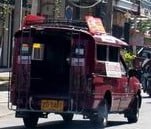
Feb 10, 2002: Songtaows are quickly becoming my primary interaction with Thai society. The Thais are highly sociable as well as curious about foreigners on their bus, so there are many chances to interact both in English and Thai — and today... Japanese.
These "minibuses" troll the the city day and night. Some concentrate on particular routes, others (most I think) go wherever the customers want, which makes them sort of like a cross between a bus and a taxi. I'd say one out of 7 won't go my way (this excludes the few that won't stop, because they don't want to interact with farangs). I don't think my destinations are necessarily that compelling, so I reckon they're going there because I'll pay. And I probably pay 25 to 50% more than a local does. Fact of life. But we're talking about 20 cents vs. 15 cents, not dollars.
Unlike say, the Number 30 bus (which in San Francisco goes South to North through Chinatown), these don't ply regular routes, so you have to be able to ask whether the driver will go to a place. An easy way is "<place> na, krap" which is a polite, tag question with an implied "go". So it's like "<place> [going] are you, Sir?*". If the response is affirmative, and I don't know what it's going to cost: "Thao rai" ("cost what?") or more abruptly, "Kii baat" (what number of baht). They often hold up two fingers — 20 baht (about 50c). This is almost always too much: I counter with 10 ("sip") or 15 ("sip-haa"). This usually works but occasionally elicits an incredulous look. I can capitulate or take another bus. "dia mai krap" (can, sir?*) or just "na krap".
There's a small twist. Many of the streets here go long distances, so the driver wants to know where on Street X you want to go. Cite the intersection and they'll price accordingly. "Sii yakk" (4 intersection — a 4 way intersection) is the nomenclature. I live on "Huay Kaew sii yakk Rincome" Huay Kaew Rd intersection Rincome. If you want to see approximately where my condo is, find the Amari Rincome Hotel Chiang Mai (put that into Google.com). It's a 5 minute walk.
Back to the interactions. Yesterday I was riding with one other person. Made a good deal to get from where I was, home for 15 baht. All of a sudden about 10 teenage girls get on the bus. These are not large busses — it's a pickup truck after all. It's now so crowded that one girl is sitting on the lap of another. They don't talk to me, but I have a feeling they're talking about me. .... farang giggle giggle... farang giggle.
This morning was even more bizarre. I get on a bus with one other person. He strikes up a conversation in English, and he speaks well (not common, I'm afraid). He's studying at Chiang Mai University (CMU here does not mean "Carnegie Mellon"). I tell him his pronunciation is excellent for a Thai student (it is) and he says "actually I'm Japanese".
I tell him in Japanese... that his English is excellent. He stares at me like I've just dropped into the bus from my home planet.
*krap (ka for women) doesn't mean Sir/Ma'am at all — but it gives that kind of polite feel to a sentence. People will think you are more polite if you speak this way. Of course, you will always be a farang — but maybe you get to be a farang dii (good foreinger).