Vet Camp
This little piggy went skree!
skree! skree!
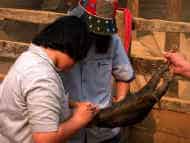
March 30, 2002:
The day after after Kathy's arrival, we set out for a three day
trip to participate in a "vet camp" near Mae Hong Son,
a small town west of Chiang Mai, next to the Burmese border. We
arrived, dazed and tired, about 10:30pm, after 5 hours of stomach-churning
turns through the mountains. The students had been waiting for
us, and we immediately were ushered to a large open-air room where
they sat in a semi-circle waiting to meet us. It was a bit daunting
to know what to say or do, but we lucked out - we were introduced,
then everyone had dessert. The next day the adventure began, but
first, a bit of background on the vet camp.
Some Background on Vet Camp
"Vet Camp" is an semi-annual event, sponsored by Heifer and Chiang
Mai University's vet school. The poor ethnic villages in
the north (with the exception of the Heifer-sponsored villages)
are generally unaware of livestock disease/parasite causes and
prevention, and can't afford veterinary care in any case. The
Vet Camp takes about 35 volunteer CMU vet students to these remote
areas to provide rudimentary animal health education and provide
vaccinations, de-worming, and vitamins. The Camp site locations
are selected to provide easy access to Heifer-sponsored villages,
but all villages in the area are invited to participate.
For the students, the camp offers the opportunity to get real
field (literally!) experience — also "pen", "corral",
and "coop" :-) For Heifer, it's an chance to visit
their sponsored villages, check on Heifer cattle, swine and fowl
placements, learn more about veterinary medicine and put the cornerstone
model tenets into practice. For the villagers, their animals get
needed vaccinations, nutritional supplements, de-worming etc. It's
a win for all involved.
It's also very cost effective - Heifer provides some base-level
funding for transportation and food. Heifer and CMU together solicit
donations of drugs and other supplies. The vet students supply
all the planning, labor, and logistics. We figured that a $2000
investment by Heifer leveraged about $20,000 worth of vaccinations
and other care. Over the course of the three day camp, several
thousand pigs, buffalo, cows, chickens, dogs and cats received
vaccinations, supplements, and de-wormings.
The program is all volunteer and entirely student-organized and
run. They spend several months planning, and are incredibly organized.
Students from all six years of the program participate, and they
take care of all the mundane chores such as cooking and cleaning,
as well as animal care.
Kathy and Scott at Vet Camp
Not knowing a whit about administering vaccines or catching piglets,
we performed the role of interested onlookers and photographers.
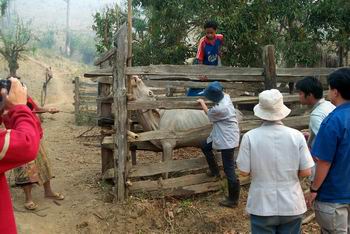
First thing in the morning, we headed out to a Lahu village to
vaccinate pigs and cows. The vet camp had gone there a year earlier
for the first time, and this time the villagers were
eager to have their animals vaccinated. Kathy's favorite
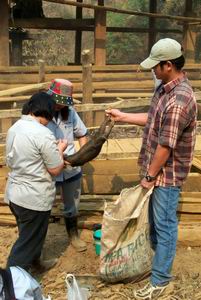
was the vaccination of the piglets - they are chased around by
the students, then stuffed into a burlap bag when
caught. They come out one at a time to get jabbed, and get a white
mark spray-painted on their back to indicate they've been taken
care of.
There was a soldier that accompanied us the whole time - there
had been some unrest from Burma that spilled over the border into
Thailand a few weeks ago (we were about 10 miles from the border),
and the government in this area, which thinks very highly of this
program, insisted on sending a soldier along. Things were entirely
peaceful, and the soldier was very very bored.
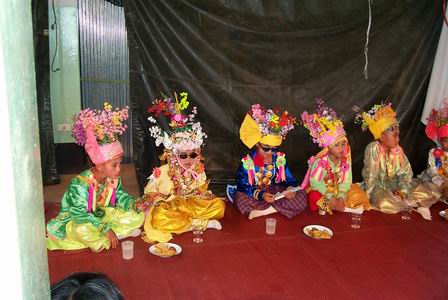
By coincidence, the central village we were staying in had a
big Buddhist celebration going on, and we took a break from animal
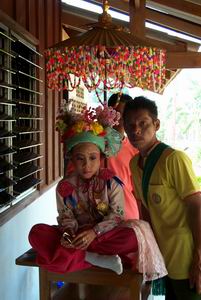
husbandry during the afternoon to observe. It is a tradition
that boys spend a month at a Buddhist temple before they become
adults. There is a big village-wide celebration for the three days
before they are due to enter the temple. This ceremony is held
only once every 3-5 years, so boys anywhere near the right age
sign up when one comes around. During the three day celebration,
their feet are not to touch the ground (outside). And, as
a group, they have to visit every house in the village in order
to bless it. As they visit a house, they are given candy and cookies
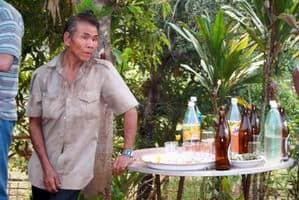
and soda pop; there are stronger refreshments laid out for the
adults as well. The boys ride from house to
house on their father's shoulders, and are accompanied by number
of other male relatives and hangers-on as well as a small band
playing various drums and cymbals. (The wives are apparently
back home cooking food for the big bash at the temple.) It takes
three days to visit all the houses in the village.
It appears
to Kathy that this is mostly a celebration for the men, who
eagerly dig into the beer, Mekong whiskey, and other treats
that are provided.
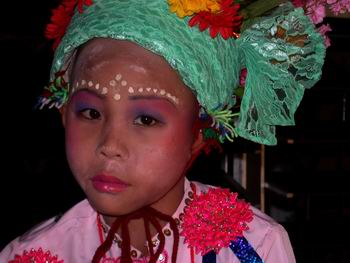 The
boys seem a bit overwhelmed by it all, or maybe they are just
tired.
The
boys seem a bit overwhelmed by it all, or maybe they are just
tired.
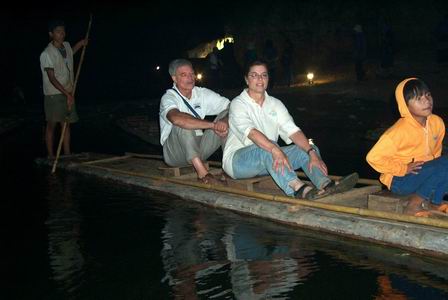
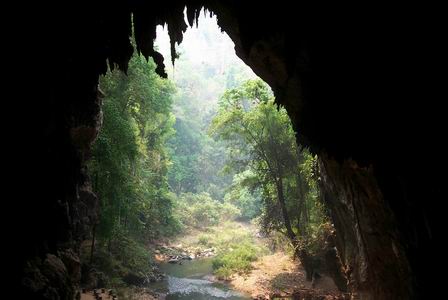
We stopped on the way home to visit one of the many cave systems
that riddle the area. Nice cave - best part was in the middle,
which one can only traverse by riding on a rickety raft done
the river.
More photos (and there's
a separate page of
them, too)
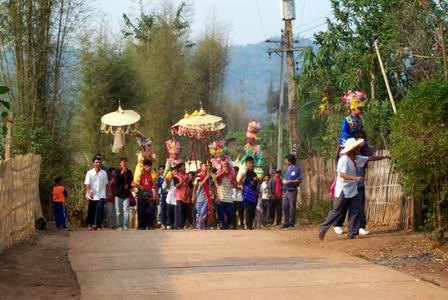
 Procession
for the monks-to-be
Boys
stop by our "camp"
Unhappy
cow about to get vaccinated
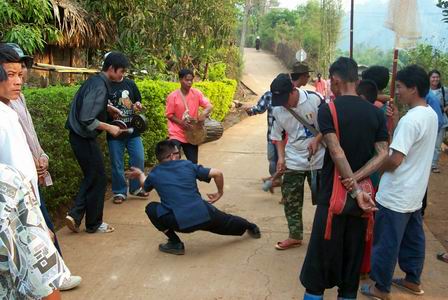
Breakdancing,
Villager-style
Procession
for the monks-to-be
Boys
stop by our "camp"
Unhappy
cow about to get vaccinated
Breakdancing,
Villager-style
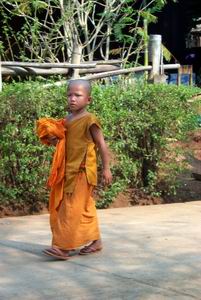
 Youngest
Monk in village
Heifer's
Aryuwath and Vet student (and bag full of piglets)
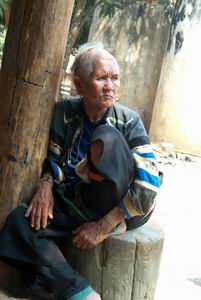
Villager
Boy's
feet aren't allowed to touch the ground. Dad's Taxi service!
Youngest
Monk in village
Heifer's
Aryuwath and Vet student (and bag full of piglets)
Villager
Boy's
feet aren't allowed to touch the ground. Dad's Taxi service!
 "Pig
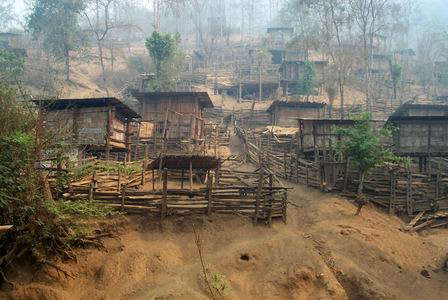
condos" — pens go up the mountainside
Our
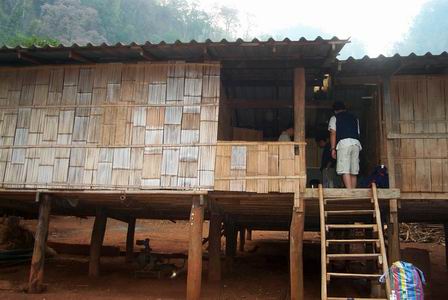
2nd night's lodging
Riding
rickety raft through the cave
Raft
journey's end
"Pig
condos" — pens go up the mountainside
Our
2nd night's lodging
Riding
rickety raft through the cave
Raft
journey's end