 Liars,
Beggars and Thieves
Liars,
Beggars and ThievesTravel gives us the opportunity to learn about others: their lives, the places they call home, their customs, their sense of what is right and what is not. It also reinforces our awareness and appreciation of the wide (and growing) chasm between the developed world and the developing world. "The rich get richer, the poor get poorer" the saying goes.
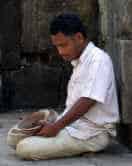
Most of the world is not like the U.S. This should be common knowledge to anybody over about age 5, but it's only when you get to some of the more remote parts of the world (and there are fewer "remote" parts each year), that you see just how different things are. My original topic for this particular diatribe was just "how to deal with beggars". It's not as simple as you might think. But as the title suggests, there's a common thread between "beggars, liars and thieves" — poverty. Drugs aren't nearly the problem (crime-wise) in Asia that they are in the States (here in Asia, the penalty for trafficking is often death — very low recidivism). Moreover, there is a strong moral code that pervades the predominant religions of Buddhism, Hinduism and Islam, surrounding crime to others, and charity. So while there are surely exceptions, I think the majority of folks you see begging on Asian streets are simply... poor.
Then here's the 64¢ question: do you give money to these people? Why? Why not?
This last items sounds mean spirited: "how could you think somebody could do that". Guide books mention it, and closer to home (so to speak), Kathy spotted a clean, well-dressed Grandmotherly type "prepping" a waif-looking child, as if to send it off to beg. I suspect this does happen. There have even been reports of children being maimed in order to be more "attractive" for begging. That's sick. I've seen one beggar wrapping up a perfectly normal-looking arm in a bandage. Doesn't inspire generosity.
You might have concluded already that we don't often give money to beggars. Even though it "feels right", it really isn't right. But travels in developing countries have made more more generous in supporting causes which seek to eliminate poverty.
There's an expression from the old South (of the US) — "Yankees are worth as much as a bale of cotton, and they're easier to pick". It refers to southern Sheriffs' past(?) tendencies to stop Northerners' cars, to extract money in the form of speeding tickets at questionable speed traps.
But where's the line, between a filthy rich (relatively) Tourist getting charged bit more than a local, outright deception, and criminal behavior? That line isn't in the criminal code, it's in the implied relationship between the local people (who may or may not be in the mainstream Tourist trade), and visitors. For me, based on my moral upbringing, it wouldn't occur to me to overcharge a visitor for something. I might even err in the other direction to ensure he got good value. But it's not the same everywhere, despite the universality of "The Golden Rule" ("do unto others as you would have them do unto you", or some variation on that theme). Let's look at a couple of cases:
This is a classic. The technique is already described on the Hanoi page. Three people collude to try to get us into an unlicensed taxi, and once we're in a seemingly-licensed taxi, the driver picks up somebody who tries to convince us that our hotel is closed, and that he should take us to "a better one". We know why it's better (because he'll get paid for bringing us there).
This is actually a crime in the US (and maybe in Morocco). We had it perpetrated on us when we visited there in Summer 2001. Here's how it goes:
After negotiating the price of a taxi ride with the driver, we set off to see Casablanca. We stop at a couple of shops where the driver knows he can collect a commission. This is pretty standard practice, but we don't "bite" because we don't usually buy the Tourist junk anyway, and almost never at this shops (the prices are inflated to pay the commission). We ask to stop at a bank to change money. Here's where the deception begins. The driver doesn't refuse outright, but instead offers to front the money. Kathy falls for a couple of scarves in the market. We don't know the real value, but she pays a relatively large amount for them. We buy some other, lesser items. Each time the driver pays.See the scam yet? The Driver negotiates with the Merchant in Arabic/Berber (local language) at a far lower price than she agrees to (in fact, she's negotiating in dollars; he's paying local currency (Dihram). The price goes on our "tab" (due to the driver's kind offer to front the cash). He pays an undisclosed amount to the merchant, and pockets the difference.
This happens a couple of times in the course of the day. I think we even get ripped off at lunch — which we offered to buy for the Driver if he'd take us to a local joint.
After completing our tour of Phnom Penh, the Driver/Guide for the day asks us when our flight (its actually a boat) leaves. Kathy and I both see this coming. Do you? He's going to assign himself to be our driver: "Oh, 7:00 boat? I should pick you up at 6:20, then". We knew what we were in for, but under other circumstances we might have "signed up" for something we really didn't want/didn't want to pay for, but would feel the moral obligation to go through with it.
I have to admire this one. Aforementioned Driver drops us off at the dock (heck, at least it was the right dock this time) and we head for the boat. As we're about to get on board, a guy approaches us: "You're from the Juliana Hotel, right? We've arranged a Driver to meet you at the dock in Siem Reap, and to bring you to our recommended hotel".
Spot the scam? There's no practical way for this guy to know we're from the Juliana. The taxi driver told him. He's working with somebody in Siem Reap who will "guide" us to a "partner" hotel (or one that will pay him a commission) — and unsuspecting Tourists that we are[n't] — we'll think the Juliana hotel has done this as a courtesy!.
We tell him we did not ask the Juliana for a pickup at Siem Reap, and that we already have a Guide. He doesn't seem at all phased at this.
Compared to say, major US cities, absolutely. With the possible exception of Phnom Penh, Cambodia, nowhere we have been is "dangerous" as American's think of it: armed robbery/mugging, rape — violent crime.
Crime in developing countries is generally pretty tame, and opportunistic. Take your wallet out and leave it on the subway (were there one), you probably won't see it again. Have $20 bills hanging out of your pockets — they may not be for long.
It pays to be aware anywhere — but we've done almost nothing in terms of changing the way we vacation, based on security fears. The biggest risk is staying home "where it's safe", and missing the world around us. No risk of that for us.