
Our local contact, K. Prmoate, Thailand/Laos Country Director, gave us a call upon our arrival, and we got invited to join them for dinner at a resort about 30km away: the entire staff was assembled and was doing its annual strategic planning. It was an honor for us, we were the only such guests and placed at the center of the table, treated with hospitality even above and beyond the normal warmth typical of Thais. It was the "kickoff" for the wonderful experience that followed over the next several days.
 We
were introduced to K. Yotsawin Keukeawkasem, who is responsible
for Resource Development in the region. No mean feat. Young,
passionate about his work, enthusiastic, knowledgeable, multilingual
(Akha, Thai, English), Yotsawin picked us up the next morning,
and we were off to the north (from where we'd just flown...).
Our first village was a Lahu tribe village (the same tribe as
Kathy's foster
child). Below are some photos and commentary from the
two days we spent with him.
We
were introduced to K. Yotsawin Keukeawkasem, who is responsible
for Resource Development in the region. No mean feat. Young,
passionate about his work, enthusiastic, knowledgeable, multilingual
(Akha, Thai, English), Yotsawin picked us up the next morning,
and we were off to the north (from where we'd just flown...).
Our first village was a Lahu tribe village (the same tribe as
Kathy's foster
child). Below are some photos and commentary from the
two days we spent with him.
The central focus of Heifer's work is upgrading the quality and care of livestock, as a way of increasing self-sufficiency and improving living standards. Heifer has a very clear set of guiding principles for their projects, their "cornerstones". The core is "passing along the gift" - the first offspring of an animal Heifer has supplied to the village is passed along to another family or village. Another principle is that the villages drive the direction of the projects, provide necessary labor, and that upfront costs (eg animal feed) must be repaid with interest. Every project is somewhat different, because the needs and desires of each village are different. Heifer is very focused on the long term sustainability of the project - both in terms of whether the villages will be able to keep the projects going by themselves; and in terms of its impact on the environment. There is a significant amount of training involved for the villagers; they even train one or two villagers as "para-vets" to do routine care like vaccinations. The Heifer employees act mainly as coaches, facilitators, and on-call experts. A successful village becomes a role model for other nearby villages, with much of the subsequent knowledge exchange going on between villagers themselves, without as much assistance from Heifer. The result is an extremely practical and cost-effective grassroots approach that changes the world one village at a time.
The office in Chiang Mai that hosted us for this trip is responsible for projects in Thailand (mainly working with the hill tribes), and indirectly, working through partner NGOs, in Laos and Burma. There are nine people in the office; most of them with degrees in animal husbandry or similar. Three of the staff members are themselves of hill tribe origin who were able, despite difficult circumstances, to obtain an education. We were extremely impressed with the passion, enthusiasm, experience and knowledge of the staff we met at dinner that first evening.
Our first trip was to Nemru, a Lahu village located within a couple of hours of Chiang Mai. Heifer has been working with this small (25 family) village for about three years now, and it is impressive to see the results. They use it as a "model" village, to show other villages the first-hand results of what is possible. First, though, a short aside on the "Hill Tribes".
The Hill Tribes live, as their name suggests, in the hills (more like small mountains) in Northern Thailand, Laos, Burma, and Vietnam. There are about a dozen major types of hill tribes, and many subvariants under that. Many of the tribes originated in China and Tibet, though some have other origins. Some have lived in the area for centuries, though most have been emigrating into Thailand from Burma and elsewhere, in the last 100 years or so. With the oppression in Burma, they continue to migrate (illegally) into Thailand today. They speak their own languages, and live their lives relatively independent of Thai society. In almost all cases, they are desperately poor, illiterate, and able to scratch out only the most meager existence from their hillside fields. Few of them have Thai ID cards, which shuts them out from many of the social services and restricts where they may travel. They have no title to the land they use. You can see the Thai's government's point of view - essentially, the tribes are illegal immigrants coming for economic reasons. The Thai government has its hands full just raising all its own citizens out of poverty. The more the government provides support, the more tribe members will choose to flee Burma into Thailand.
This Lahu village, helped by Heifer over the last three years,
is markedly more prosperous than any hill tribe village we've
seen to date. The core of the project was to upgrade the quality
of pigs in the village, changing from the scrawny, slow-growing,
free-ranging "peanut pigs" to quality stock kept in
pens. It turns out that the best pigs are a cross between
the original Heifer stock, and the local black pigs, which people
prefer because of their taste and their use in traditional ceremonies.
The sign of an 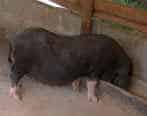 ideal
cross breed is black body with pink legs, like this gal here.
These pigs mature in 18 months (vs 3 years) and bear about a
dozen piglets (vs. 3-4). To keep the cost of feed down,
Heifer provided a loan for a feed grinder - now, instead of selling
their corn at low price to the market, then buying back
high-priced corn-based feed, they instead mix and mill their
own, cutting the cost by half. They also grow bananas to feed
the pigs. And the pig manure is used for either fertilizer or
as feed for their fish ponds (also Heifer-initiated). Households
are encouraged to grow a "kitchen garden", with common
vegetables and herbs, as an
ideal
cross breed is black body with pink legs, like this gal here.
These pigs mature in 18 months (vs 3 years) and bear about a
dozen piglets (vs. 3-4). To keep the cost of feed down,
Heifer provided a loan for a feed grinder - now, instead of selling
their corn at low price to the market, then buying back
high-priced corn-based feed, they instead mix and mill their
own, cutting the cost by half. They also grow bananas to feed
the pigs. And the pig manure is used for either fertilizer or
as feed for their fish ponds (also Heifer-initiated). Households
are encouraged to grow a "kitchen garden", with common
vegetables and herbs, as an alternative
to spending their limited resources at the market. Heifer encouraged
and supported an upgrade of the water supply, and the building
of latrines like the one on the right. Sanitation is something
we just take for granted, but latrines and clean water are a
huge first step towards healthier living . Here's Heifer's summary of
the project.
alternative
to spending their limited resources at the market. Heifer encouraged
and supported an upgrade of the water supply, and the building
of latrines like the one on the right. Sanitation is something
we just take for granted, but latrines and clean water are a
huge first step towards healthier living . Here's Heifer's summary of
the project.
The results are amazing — the houses are larger and increasingly
of permanent and sturdy construction (cement, hardwood) vs. bamboo.  Sanitation
is good. The village is tidier, and little signs of wealth are
everywhere - a few motorcycles, a boom box, etc. I asked
one of the first farmers who signed on with Heifer what he thought.
Had his life changed for the better? His face lit up in a huge
smile - oh, yes! His life was much much better. While
is oldest child was illiterate, he now had a daughter in her
first year of college. And another daughter graduating from high
school this year who will also go to college. He was planning
to improve his house, and he might even get a motorbike. As
he told us these things, he kept fondly petting the head of one
of his sows, who had recently given birth to a dozen healthy,
squirming piglets. He echoed a theme we were to hear many times
during our visits - it is too late for me (to get educated),
but this will allow my children to go to school and have a better
life. Pictures from the village are below.
Sanitation
is good. The village is tidier, and little signs of wealth are
everywhere - a few motorcycles, a boom box, etc. I asked
one of the first farmers who signed on with Heifer what he thought.
Had his life changed for the better? His face lit up in a huge
smile - oh, yes! His life was much much better. While
is oldest child was illiterate, he now had a daughter in her
first year of college. And another daughter graduating from high
school this year who will also go to college. He was planning
to improve his house, and he might even get a motorbike. As
he told us these things, he kept fondly petting the head of one
of his sows, who had recently given birth to a dozen healthy,
squirming piglets. He echoed a theme we were to hear many times
during our visits - it is too late for me (to get educated),
but this will allow my children to go to school and have a better
life. Pictures from the village are below.
We spent the afternoon driving up to the Chiang Rai area (near the Burmese border), where the other villages were. The drive was notable for two reasons — first, there were paved roads! When we were here 10 years ago (to almost this exact area), other than the main highways, all the roads were dirt, most in terrible conditions with huge gullies and washouts. Impassable mud after a rain (as we unfortunately came to learn firsthand). In the last decade the roads in this area have been improved tremendously, making the remote villages much more accessible — handy for villagers who want to sell their goods or pick up supplies at the local market. The last 1-5 miles to a village are usually on the same horrid roads as before. But at least it's not 20-30 miles of bad roads like it was earlier.
The other notable aspect of the drive was that Yotsawin was able to give us the background on how Heifer went about their work, and about the successes and setbacks they experienced. Besides being very interesting information, several very clear themes came through about their underlying philosophy (which used to create the description of Heifer above). When I later got some Heifer Intl literature, I found that from Yotsawin's project descriptions, I had been able to independently derive a good summary of their cornerstone model. I was impressed - this is really an organization that practices what it preaches!
He also told us about his background - he was born in a poor Akha village, the youngest in a big family. His parents were very pro-education, and he was one of the few in his village to receive a scholarship to a primary school in distant Chiang Rai (there were no nearby schools). He left home at age 6, and lived in a very basic hostel with 80 other children during the school year. He did well in primary school, and received one of the limited number of scholarships available to secondary school. After graduating, he received a college scholarship, where he studied animal husbandry. He also spent several months attending a short course in the US. His scholarships came from a Christian charity group, World Vision. He had a specific sponsor throughout this entire time, a woman from Australia who corresponded with him from primary school through college.

Our first stop was at Lor-Yu Akha village, where Heifer had
only recently started working and where we  were warmly
welcomed. This was a "touristed" village — when you
signed up for a day-long tour to "see the hilltribes",
this is one of the places you got taken to. The women of the
village had set up a row of little stalls throughout the village,
selling handicrafts to earn some money from the tourists. Sure
enough, as we sat on a front porch talking with one of the villagers,
a busload of tourists came, traipsed thru the village, bought
things at the shops, and left.
were warmly
welcomed. This was a "touristed" village — when you
signed up for a day-long tour to "see the hilltribes",
this is one of the places you got taken to. The women of the
village had set up a row of little stalls throughout the village,
selling handicrafts to earn some money from the tourists. Sure
enough, as we sat on a front porch talking with one of the villagers,
a busload of tourists came, traipsed thru the village, bought
things at the shops, and left.
We walked through the village with Yotsawin, stopping at several
houses to catch up with what the latest news was, with Yotsawin
giving them more information about Heifer. Several women were
out chatting, and we stopped by to say hello. With Yotsawin translating,
I asked them what they thought about the tourists coming through
their village - did the visitors do anything that annoyed them?
Perhaps they were just being polite (since I too was a visitor),
but they said, no, the visitors didn't really
bother them, and they liked the extra income. Besides, the timing
was good - high season for tourists is Nov-Feb, which is the
villagers' slow time of year (too cold to grow most of their
crops). One of the women said she felt a bit like a monkey
(ie in a zoo), but she didn't mind because the tourists bought
things from her. The village doesn't have electricity yet, and
there was an interesting discussion about whether they should
have it brought in — certainly it would be nice to have, but
one of the attractions for the tourists was that this was an "authentic" village
(ie without electricity and other trappings of civilization),
and perhaps it would be better for business to keep it that way.
really
bother them, and they liked the extra income. Besides, the timing
was good - high season for tourists is Nov-Feb, which is the
villagers' slow time of year (too cold to grow most of their
crops). One of the women said she felt a bit like a monkey
(ie in a zoo), but she didn't mind because the tourists bought
things from her. The village doesn't have electricity yet, and
there was an interesting discussion about whether they should
have it brought in — certainly it would be nice to have, but
one of the attractions for the tourists was that this was an "authentic" village
(ie without electricity and other trappings of civilization),
and perhaps it would be better for business to keep it that way.
One of the families in the village was holding a big ceremonial
lunch celebration, as a memorial to  his
mother who had passed away a month earlier and to our delight
we were invited to attend. We spent most of an hour sitting and
chatting with the men on the porch while the women were cooking
in the back room. Then we were invited inside for lunch, along
with about a dozen or more other villagers. There are two large
rooms inside a house - the front room, where we and the menfolk
ate, and a back room that is the kitchen and where the women
and kids ate. The front room was very sparsely furnished - just
a small wicker pedestal the the serving dishes were set on. They
brought a lot of
his
mother who had passed away a month earlier and to our delight
we were invited to attend. We spent most of an hour sitting and
chatting with the men on the porch while the women were cooking
in the back room. Then we were invited inside for lunch, along
with about a dozen or more other villagers. There are two large
rooms inside a house - the front room, where we and the menfolk
ate, and a back room that is the kitchen and where the women
and kids ate. The front room was very sparsely furnished - just
a small wicker pedestal the the serving dishes were set on. They
brought a lot of different
food out. I can't say I could identify all of it - probably just
as well - but I have to admit it was tasty. After a while, a
few bottles of home-made rice whiskey made their way to the front
— it was not bad, I've had worse. Much of the meal was spent
analyzing how Yotsawin might be related to people in that village
— I think they finally concluded there was some link at the grandmother
or great-grandmother level. What I got out of the conversation
was what a great benefit it was that Heifer was able to employ
people from the various ethnic groups - people who could walk
into a village and be immediately welcomed and trusted as a fellow
clansman.
different
food out. I can't say I could identify all of it - probably just
as well - but I have to admit it was tasty. After a while, a
few bottles of home-made rice whiskey made their way to the front
— it was not bad, I've had worse. Much of the meal was spent
analyzing how Yotsawin might be related to people in that village
— I think they finally concluded there was some link at the grandmother
or great-grandmother level. What I got out of the conversation
was what a great benefit it was that Heifer was able to employ
people from the various ethnic groups - people who could walk
into a village and be immediately welcomed and trusted as a fellow
clansman.
After our big lunch, a couple of the village men accompanied
us to Sansuk, the next village we were to visit. The idea was
to show them the successes that another village was having with
some Heifer projects. (Full project description here).  Heifer
often starts its work in a village by selecting one or two families
to work with - families that are very eager and willing to put
in the effort to make it work. The success of these "model" families
then encourages others in the village (and surrounding villages)
to give it a try. Traditionally, each villager works a small
plot of land near their village, where they grow corn or rice
and vegetables. The land is very steep and the soil not so good.
On the model farm that we visited, the farmer had turned his
plot of land (probably 1-2 acres total) into a multi-faceted
animal farm. He had a couple big ponds where he raised fish.
At the side of the pond were pig
Heifer
often starts its work in a village by selecting one or two families
to work with - families that are very eager and willing to put
in the effort to make it work. The success of these "model" families
then encourages others in the village (and surrounding villages)
to give it a try. Traditionally, each villager works a small
plot of land near their village, where they grow corn or rice
and vegetables. The land is very steep and the soil not so good.
On the model farm that we visited, the farmer had turned his
plot of land (probably 1-2 acres total) into a multi-faceted
animal farm. He had a couple big ponds where he raised fish.
At the side of the pond were pig pens
- the manure made good food for the fish. There were a hundred
or more geese and goslings wandering around. His cow wasn't
around - it was out grazing in a friend's pasture. He had plans
to plant some mango trees on the upper slopes. You could tell
he was very pleased with the results of his new farm - both his
smile and his plumpness spoke of his success (he's the one on
the left here). You could see that the villagers from the first
Lor-Yo village were impressed.
pens
- the manure made good food for the fish. There were a hundred
or more geese and goslings wandering around. His cow wasn't
around - it was out grazing in a friend's pasture. He had plans
to plant some mango trees on the upper slopes. You could tell
he was very pleased with the results of his new farm - both his
smile and his plumpness spoke of his success (he's the one on
the left here). You could see that the villagers from the first
Lor-Yo village were impressed.
We then went up to the village itself, to see some more of the projects underway. Lots of happy pigs in clean pens, a feed mill, latrines, some permanent buildings, and some really excellent kitchen gardens. Quite a contrast to the village we'd just come from. The men from the two villages talked some more, with one of the Lor-Yu villagers deciding that he might take the chance on running a feed mill, or perhaps digging a fishpond. Another village on its way to prosperity, thanks to Heifer and to some villagers willing to take a chance.


 Another
livestock upgrade - new chickens, with their own coop
Feed
mill which cut the cost of animal food in half
Happy,
healthy, penned pigs
Another
upgraded house
Another
livestock upgrade - new chickens, with their own coop
Feed
mill which cut the cost of animal food in half
Happy,
healthy, penned pigs
Another
upgraded house


 "No
drugs in this household" - Heifer supplies livestock only to households
that promise to remain drug-free, a big incentive
Clean
water supply - very important
Villager
explains that through Heifer's help, he now has two daughters in college
Another
sign of success - motorcycles around the village
"No
drugs in this household" - Heifer supplies livestock only to households
that promise to remain drug-free, a big incentive
Clean
water supply - very important
Villager
explains that through Heifer's help, he now has two daughters in college
Another
sign of success - motorcycles around the village


 "Million
dollar view" from a front porch — not unusual in these parts
Tourists
visiting Lor-Yu village
Kathy
once again wows the hilltribes with her home photos
Akha
woman in typical headdress
"Million
dollar view" from a front porch — not unusual in these parts
Tourists
visiting Lor-Yu village
Kathy
once again wows the hilltribes with her home photos
Akha
woman in typical headdress


 Akha
village houses - before upgrading
More
Akha women
Making
traditional handicrafts — mostly for tourists in this village
Kid's
hat
Akha
village houses - before upgrading
More
Akha women
Making
traditional handicrafts — mostly for tourists in this village
Kid's
hat


 Chilies
dry in the sun
Men
chat while the woman prepare a feast
Men
drink while eating feast (this was a ceremony/get-together to honor
a recently deceased relative
Village
teen picking tonight's "catch" from the kitchen garden —
a Heifer trademark
Chilies
dry in the sun
Men
chat while the woman prepare a feast
Men
drink while eating feast (this was a ceremony/get-together to honor
a recently deceased relative
Village
teen picking tonight's "catch" from the kitchen garden —
a Heifer trademark
Return to blessley.net