Northern Viet Hills 10/31-11/5
See also the "Sa Pa" page, with highlights from the Sa Pa weekend market, and the Cat Cat waterfall.
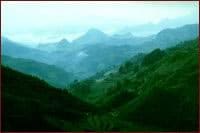
This stop is 4 days in the "Tonkinese Alps", in the far north of Vietnam, very near the Chinese border. The scenery is stunning, and it is home to many colorful ethnic minorities. We were quite decadent and taking a tour that includes transport in a private railway carriage and staying at a lovely hotel. Major activities in SaPa center around trekking, visiting the Hill Tribe markets, seeing the beautiful landscapes.
Background: Sapa is still a must-see on any northern Vietnam
itinerary. On a clear day you will be treated to views 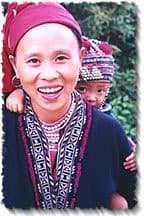 of
steeply terraced rice fields, towering verdant ridgelines, primitive mud-thatched
villages, raging rivers and astounding waterfalls. Nestled high in the Tonkinese
Alps near the Chinese border, Sapa was built as a hill station during French
colonial days, to serve as a respite from stifling Hanoi summers. These days,
weekends are still the biggest draw in this crumbling hill-tribe center.
Visitors from the capital flock to Sapa for a glimpse of the famed "Love
Market," a trek to local hill tribe villages, or an ascent of Vietnam's highest
peak, Fan Si Pan. Some eight ethnic groups inhabit Lao Cai province: Hmong,
Dao, White Thai, Giay, Tay, Muong, Hao and Xa Pho.
of
steeply terraced rice fields, towering verdant ridgelines, primitive mud-thatched
villages, raging rivers and astounding waterfalls. Nestled high in the Tonkinese
Alps near the Chinese border, Sapa was built as a hill station during French
colonial days, to serve as a respite from stifling Hanoi summers. These days,
weekends are still the biggest draw in this crumbling hill-tribe center.
Visitors from the capital flock to Sapa for a glimpse of the famed "Love
Market," a trek to local hill tribe villages, or an ascent of Vietnam's highest
peak, Fan Si Pan. Some eight ethnic groups inhabit Lao Cai province: Hmong,
Dao, White Thai, Giay, Tay, Muong, Hao and Xa Pho.
11/01/01 6am: The train ride was comfortable enough and uneventful; we found out only at last minute that we would be in a shared sleeper, ostensibly with two other people — but the other berths weren't booked so we had the place to ourselves. The train leaves at 9:30pm and arrives in the morning, so there' wasn't not much to see. We both slept well.
Sa Pa is lovely; it's become the de facto Tourist Capital of northern Vietnam since about 1993, but it still retains small town appeal. There are only a handful of cars, and the streets by and large are quiet except for some motos and bikes. The central market is fairly large, providing a host of services for both locals and tourists. Hmong people hawk their wares — elaborately decorated and dyed fabrics and clothing. They get annoying but I guess it "goes with the neighborhood".
11/01/01 10am-ish: We wandered around Sa Pa, finally stumbling on the Central Market. Scott hadn't shaven, stimulating great interest on the part of numerous street-Barbers. Some actually rubbed his face and guided them towards their chairs. Would have been an interesting cultural experience — but not at the possible risk of AIDS, or some variant of hepatitis we don't have shots for.
11/01/01 2:30pm: Part of our package included a 2 hour visit to two different hill tribes, with an easy 2km walk. This turned out to be about 3 1/2 hours (2 1/2 walking) through precarious muddy paths, along the tops of rice-paddy walls etc. Scott nearly fell a couple of times - it would have made for entertaining photos, but he would not have been amused. Kathy, ever the profligate spender, had paid 1,000 dong (can you imagine? Our retirement money going down the drain) for two walking sticks. That's about 14¢.
Throughout the tour we were "escorted" by Hmong girls and women: "You buy this from me? / Why you no buy this from me / Where you from? / This is very beautiful. / What is your name? / My mother mad at me if I sell that price". It was good natured albeit relentless. The prices got lower as the trek progressed... Kathy bought a lovely embroidered pillow cover for about 30,000 dong — about $2.
We also visited a village of the Giay people. They where not very interested in us, and didn't seem especially interesting either. We only spent only a fraction of the trip waddling through their mud.
So, is tourism good for the Ethnic Minorities? It gives them some much needed income (basically, they are impoverished subsistence farmers), improving their health and nutrition. But it also will eventually change the very lifestyle that tourists have some to see, and will change their village culture, not always to the better.


 Little
keeps Kathy from sleep
Victoria
Sapa hotel
Sapa
Little
keeps Kathy from sleep
Victoria
Sapa hotel
Sapa


 Town
common: brings new literalism to "airing one's laundry in public"
"Dog
Meat"
Hmong
marvel at the Hornbach family
Town
common: brings new literalism to "airing one's laundry in public"
"Dog
Meat"
Hmong
marvel at the Hornbach family


 OK,
they were cute
Hmong
Village
Boy
selling walking sticks
OK,
they were cute
Hmong
Village
Boy
selling walking sticks


 Sapa
Central Market
Village
electric supply
Got
mud?
Sapa
Central Market
Village
electric supply
Got
mud?