Galapagos
Islands
Part
2 of 2
The Circus
Perhaps as interesting as the place itself, was the melee that attended
our visit. As mentioned above, the Discovery was the first cruise ship
to visit, other than the small local ships that do week-long island-hopping
trips, holding 20-40 passengers. The ship had been working on getting
the licensing and making arrangements for over three years.
Even as we began heading back across the Pacific from New Zealand, passengers
began asking about plans and excursions in the Galapagos. None of the
staff could tell us – things were still under discussion with Ecuadorian
and Galapagos authorities (the two camps being distinctly different).
Though there is a pretty standard set of processes and certificates
for a ship entering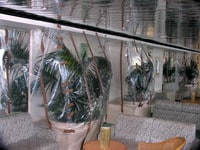 an
environmentally-sensitive zone, the Ecuadorians had no previous experience
with it, and each ministry and official set their own rules. We had to
go out 80 miles to discharge gray water; no, make that 60 miles; wait,
it's 100 miles now. We had to buy fish from the local fishermen – no,
wait, we weren't allowed to buy any fish locally [the cruise line
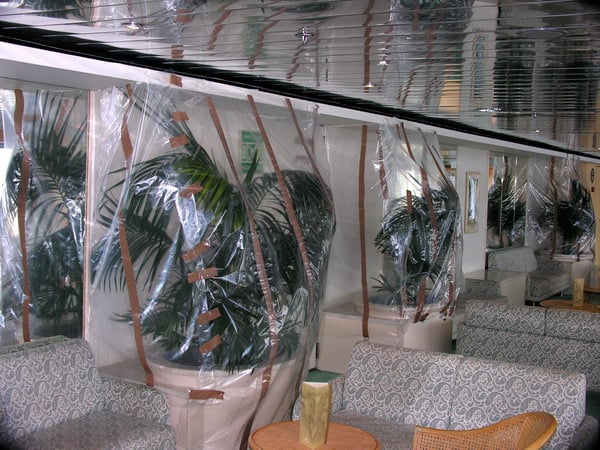
has a policy of supporting local business when it can]. The photo at
right shows some of the quarantined plants on board; others were removed
from rooms and stored in sealed-off areas.
The ship eventually
called in Dr. Peter Carey, Discovery's Antarctic Naturalist, to come
to Galapagos and try to reason with the officials and straighten things
out. On and on it went; fortunately, little of it affected the passengers
before arrival. After three years planning, everything was down
to the wire.
We picked up about a dozen corporate people from Voyages of Discover
HQ in Manta, including the big boss. They seemed to both help as well
as add to the confusion. We also picked up a bunch of Ecuadorian officials,
who went around enforcing and checking, checking and enforcing; being
from different factions, they enforced and checked the very same things
at different times and often with different requirements.
It was wearing on the staff, and starting to grate on the passengers.
 The
ship
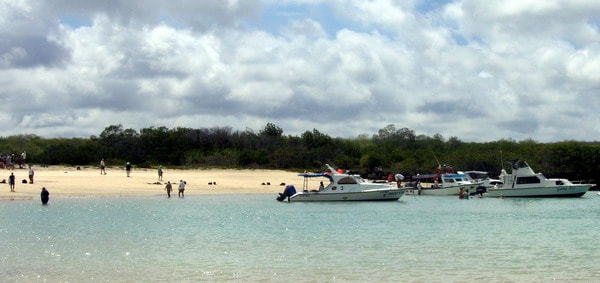
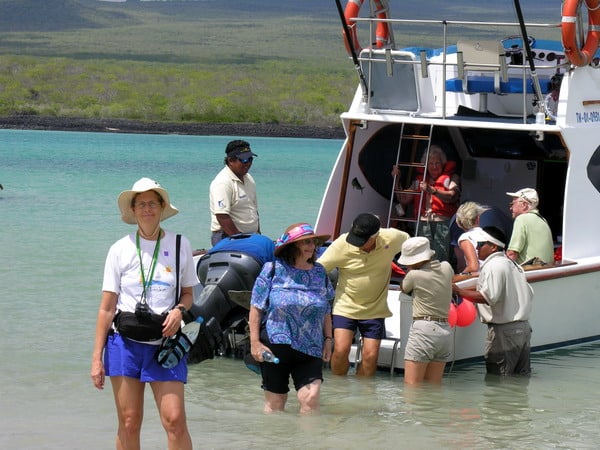
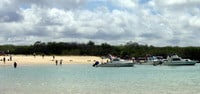
hired local boats to take us to the various nearby visitor sites. It
was quite a motley assortment, most holding 10-15 people. There was an
elaborate colored sticker matching system to get the right number of
people on each boat in the right order. To make matters more complicated,
we were anchored, not docked. A line of little boats snaked away from
the ship's gangway. It involved lots of waiting around as 300+ people
got loaded fifteen at a time.
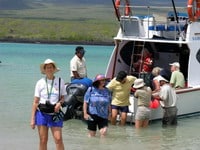
Kathy awaiting return of our tour
Even more complicated were trips to some of the more distant islands.
There were only a limited number of boats allowed to visit these islands,
and competition was fierce to get a seat on them. We managed to finagle
tickets to Española, which was a two hour boat ride (again, in
the little local boats).
The night before, we got a notice saying it was
in fact a four-hour boat ride in each direction, and we'd
be leaving at 6:30am, returning 12 hours later. That was too much for
us, and we turned in our tickets.
As it turns out, the two boats headed
to Española BOTH broke down. The first to break down transferred
all its passengers to the second, making it very cozy (not to mention
unsafe). They didn't arrive on Española till after noon, where they had,
by all accounts, an absolutely fabulous time. When it came time to return,
the first boat had managed to restart, but now the second one broke down
just after leaving. Eventually, the Ecuadorian navy sent out a fast boat
to pick them up and two them home – arriving
at 10:30pm.
The next day, we were booked on an excursion to a second, not-quite-so-distant
island – that ended up being canceled at 10pm the night beforehand.
Every 2nd night, the ship had to steam 60 miles out to sea to discharge
gray water. When the staff saw how many problems the Española boats
had getting back on time, they cancelled the trips for the following
day because they were worried the boats wouldn't return in time for the
ship to head out to sea. We stayed onboard all day, to recover from all
the commotion.
As we visit the island, the island visits us
 While
half the ship's staff were pulling out their hair over the tours,
half the island was visiting the ship. Throughout the entire
journey, we've had at least half a dozen local officials onboard, usually
related to ensuring we are not bringing in pests of any sort. For the
Galapagos “new
port visited” ceremony, about eight officials were supposed to
come – but 39 showed up. The environmental minister showed up with
his family and entourage, and stayed overnight on the ship, and did many
other officials. Ecuadorian children ran up and down the corridors while
their parents took advantage of the no-cost bar. As the Captain said
afterwards, "Half the population ate all our food, and the rest
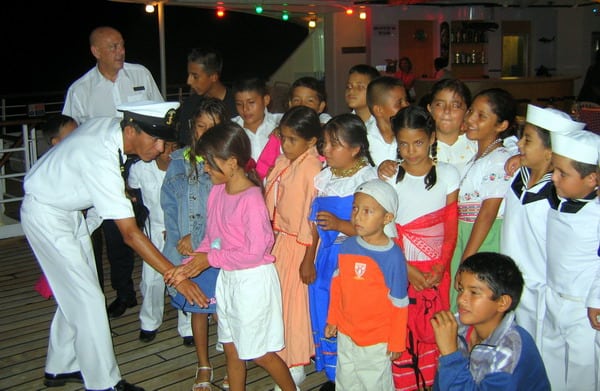
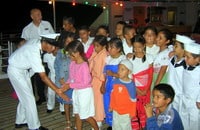
finished our liquor". Various groups of singing and dancing children
showed up – unannounced. One evening there were three different
sets of performers that appeared – the last one with 40 kids – bobbing
about in boats by the gangway, while the staff tried to figure who they
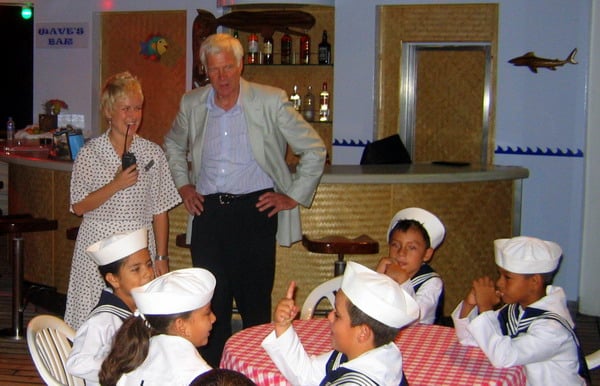
were and what to do with them (they were given orange sodas and a tour
of the ship).
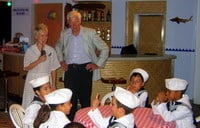
Future Ecuadorian Sailors
Moving On
In the middle of our chaotic stay in the Galapagos, a new cruise segment
began, and half the passengers were replaced by new ones – flying
via tiny San Cristóbal airport and being tendered, with all their luggage,
onto/off of the ship.
When we finally sailed away after our five-day visit, both the crew
and the passengers heaved a big sigh of relief. It was a fascinating
place to visit, but we all looked forward to getting our ship back and
returning to our normal calm routine. The Crew had a party -- maybe two
or three of them.
 an
environmentally-sensitive zone, the Ecuadorians had no previous experience
with it, and each ministry and official set their own rules. We had to
go out 80 miles to discharge gray water; no, make that 60 miles; wait,
it's 100 miles now. We had to buy fish from the local fishermen – no,
wait, we weren't allowed to buy any fish locally [the cruise line
has a policy of supporting local business when it can]. The photo at
right shows some of the quarantined plants on board; others were removed
from rooms and stored in sealed-off areas.