Scott rambles on...
about life after Lucent*
"So, what do you do?"

"Can you believe this, Zoë? They're retired. And he doesn't look a day over 35"
We're early retirees. Very early retirees. We cashed out and left the corporate world at age 45. No, we're not rich. No, we're not dot.com millionaires. No, we didn't inherit any money. We both had well-paying jobs in high-tech, no kids, and are both frugal by nature. Back in 1992, Scott happened upon a book called "Cashing In on the American Dream - How to Retire at 35" by Paul Terhorst. Its premise is that, with a good job, a good savings plan, and a frugal lifestyle, many people in this country would be able to retire very young. We ran the numbers, cut our spending some more, and put together a plan to retire in six years. We ended up waiting a couple of extra years to retire, riding the crest of the dot.com boom. But when we both got laid off during the dot.com bust (on the exact same day!), we were ready for our retirement to begin. Here's a bibliography of books we found most useful in planning our very early retirement; and here are the slides from an adult ed course Kathy teaches on the subject (contact Kathy if you're interested in having it taught in your area).
While retirement this young may seem uncommon, there are a surprising number of high-tech people who are "dropping out" of full time work between their mid-40s and mid-50s. Sometimes they switch to part-time, sometimes to free-lancing, sometimes to a hobby-related job. And often they just stop work entirely. We know dozens of people who have done this, but the trend has gone largely unnoticed by the world at large. We'd be interested in your comments on the topic; drop us a line with your vantage point.
"Anything we want"

What to do? What to do?
This is pretty much true; we can do basically anything we want. It's not that we're especially affluent, it's that our needs are simple (and we've done a lot of advanced planning).
What constitutes "anything" needs be evaluated in the context of the resources you have (money, health, location) - but more importantly, in the context of what you desire. Could we charter a jet and fly off to the south of France on a whim? Possibly. But would we want to? No. The secret, then, is in changing your relationship with money. It's not about taking a vow of poverty, giving away all your worldly possessions, and foraging for nuts and berries. It's about deciding what is important for your time on the planet, and applying your personal and financial resources - whatever their magnitude - to the task. More on this a bit later.
If I may digress a moment: we came back from somewhere recently (now there's news). At Immigration, they usually start with mundane questions ("How where have you been on your trip?") - to see whether the person trying to enter the US is nervous. I mean they've already looked at the form, they know where you've been... They want to interact with the people entering the country, so they can ferret out the squirrelly ones. Or is it squirrel out the ferrety ones?
The Immigration Guy looks at Scott's passport (which is about a half inch thick, with 53 pages, almost all of them used) and says "So, what do you do?". Not thinking that he means "Why is it you've got stamps from all over the world (including all over the Arab world) in your passport", I reply thusly ("Just about anything I want"). I didn't mean to be flippant, it's just the first thing that came out.
The guy frowns a little bit, and says "Work with me here, will you?" Smiles on both sides of the counter; I explain my former life. They let me back into the US anyway.
"Oh, we're retired"

"Well, usually we drink cheap wine beginning at
dawn, and sit in our Lazyboy recliners all day"
Actually, we don't. At least the drinking part.
This one works better, and I use it most often. The usual response is "You're so young!". I'm sure I blush at this each time. Like our identification of "life" with work, we identify "retirement" with "old". Why is this so? Well the obvious answer is that people are conditioned to work until "retirement age", and that age, in the US, is around 65. It seems pretty arbitrary, though, doesn't it?
But why do we work this long in life? If you're like most people, you think this logic bizarre, that it's not as if there was a choice. Or that in order to do this, you have to amass a huge amount of money. This is a myth.
Trading Your Time for Gold
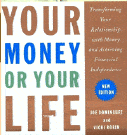
In "Your Money or Your Life
Basically (read the book... or at least the summary) their premise is that we live a certain amount of time on earth, and spend a subset of that time working. We trade the results of our work (money) for things. To the extent that work is not "play" (and that amount varies for each person), we are merely trading the time we spend toiling in order to support our consumption. Of course it's not that simple: the kids need clothes, the family needs a home. We can't just stop working and party the rest of our lives.
Related pages:
Early Retirement Bibliography PDF
Having a Life editorial
Slide set from Kathy's "Having a Life" course (PDF)
*and Digital and Cascade and Ascend and Nervewire and NCRI and Astral Point...