Amari Rincome
La Gretta Rest.
Amari Rincome
La Gretta Rest.
Feb 26, 2002: Everybody's looking for something: the proverbial greener grass, pot o'gold at the end of the rainbow. The One True Way. God, maybe. It's the journey, not the destination (now there's one I believe in). In the course of the search, some try to become something they aren't — or perhaps can't, be.
I haven't shaved my head (not that anybody'd notice, these days), given away all my worldly possessions, and moved to the forest to forage on nuts and berries. Nor am I planning to. But I am noticing increasingly, that I'm embracing the Thai sense of (financial) value, while also trying to observe other Thai sensibilities like interpersonal relationships, personal space, their wonderful sense of fun. No matter how hard you try, you can't be Thai unless you started that way. I don't especially want to be: true, the "grass is green" in a number of ways, but its gray in others and downright burnt to a crisp in some cases.
My "run rate" (daily expense rate) in Thailand has been about $13 per day. To be fair, Heifer International has paid my rent, and that amounts to about another $9/day (which isn't bad for a luxury condo). But also to be fair, it does include all my travels within Thailand including one flight so far, lodging and all the costs to equip that condo. Stocking the frig'. Cleaning supplies. Bedsheets, soap... meals. Transportation. Thirteen bucks a day. Remember back to when you moved to your first "home away from home", how expensive it was and how many things you now take for granted. Back then I was shocked at what washing machines cost — but then I haven't had to buy one since 1985 or so. I bet they cost more now.
If you tune in for the word in the markets and shopping centers you'll here it too often: Paeng! Expensive! All foreigners (farang) are seen as rich, maybe filthy rich: "how else could you come to our country and not work?". On the one hand they're right. And maybe we should pay more for everything... because we can? An analogy that I think applies goes like this:
You walk into the neighborhood convenience store in the US. The Owner is invariably an immigrant. Why? Because they're willing to work hard at menial jobs for low pay to get ahead — because the alternative (begging, perhaps) is contemptible to their culture — or because they recognize that hard work in America can pay off, eventually. Whatever. You go and buy your $1.50 gallon of milk. When the clerk tells you the cost, you say "No, please take $2.00".
Yeah, right. Not in my lifetime.
But here, the equivalent happens all the time. The Thai would be perplexed and bemused if a taxi driver asked twice the regular rate to go a bit further. But I'm regularly asked for three, sometimes four times the "normal" price. And I can predict in advance whether they driver will back down: If he gives the price in English, I'm screwed. If in Thai (and I respond in kind) there's hope. Sometimes I pay more. Usually I say "mai pen rai" ("no problem"), smile, and step away.
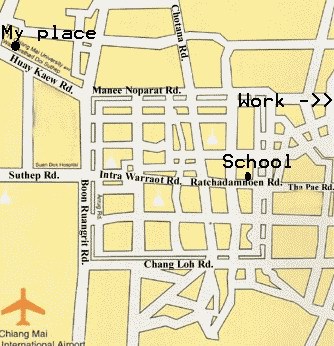
However, when you choose to enter a farang enclave, you choose to pay the farang rate. Such was my breakfast this morning. I live within spitting distance of the Amari Rincome Hotel. It's a nice little property, sort of a little oasis just a little out of the way from the bustle (such as it is) of Chiang Mai. It is populated with affluent, mostly elderly Brits and Aussies, I think, and a few assorted other Europeans. I can't imagine staying there. Outside, Predator taxis and tuk-tuks await farangs who will pay the "special" rate.
I went there because today is Maka Bucha, a significant Thai Buddhist holiday — and not much is open yet. And I'm out of milk. And it's a 5 minute walk. How much can it cost for breakfast? Well, it costs ten bucks! I can hardly contain my astonishment. I've gotten completely used to paying 20 baht (less than 50 cents) for a meal — even a packaged supermarket meal. I've been inculcated with that Thai sensibility for costs. Is this a bad thing?
I'm committed now, I could order off the menu but basic breakfast is 400 baht and coffee will probably add another 50; the buffet's B460. It better be good. It'd better be stupendous. It isn't. The fruit pales in comparison with what I find from street vendors for 10 baht. The coffee is weak (expecting Americans?). They've got waffles. I love waffles. I ask for two and they go to plate them from the small stack that I assumed was just for display. "ron mai?" (are they hot?). "Mikowave dai, krap" ("We can microwave them"). For this I paid ten dollars? Cook me a damn waffle and nobody gets hurt! (I don't say this, I wait, while the microwave does its magic. It's ok). I remember that I've paid $35 for some brunches elsewhere (like Hong Kong), more in the US — although then they were fabulous. But mai pen rai.
The Waitstaff see that I've got my course book, and it's written with English and transliteration on one side, and Thai script on the other. They all change to Thai, which is wonderful because what they say to me is short ("want coffee") and in context (they're probably asking about food), so I pretty much "get it". This is almost worth the price of admission — but I could get the same at JJ's for a 3rd of the price, and their coffee's good. Without the crowds or institutional food. [Update: the closest place with American Breakfast turns out to be a Japanese restaurant across the street and down towards town a little. Score: Amari: B460. JJs: B150 (but great OJ). Japanese place: B78 with excellent coffee (adequate juice) and service that was just bizarre. It wasn't anybody's culture: not American style, not Thai — not even Japanese. I think the servers were just visiting this planet]
I stop in their lovely lobby and read one of the English language newspapers. There, I've recouped 20 baht. Ahhh.